
Singalila National Park is a national park of India located on the Singalila Ridge at an altitude of more than 7000 feet above sea level, in the Darjeeling district of West Bengal. It is well known for the trekking route to Sandakphu that runs through it.
The jungles in the east are treasure houses to the most precious and strange flora and fauna. One such treasure in the east is Singalila National Park in West Bengal. Established in 1986, the park is one of the few places on earth where you will come across Red Panda.
The incandescent view of Kanchenjunga Massif adorn the clear blue skies above the park. Each and every turn unfurls a pleasant surprise of wilderness and scenic beauty. Located in the Eastern Himalayas, you get the virgin views of the mountains spanning from Nepal to Bhutan.
It is a heaven for wildlife photographers, nature lovers, and adventure enthusiasts.


☆ Natural history –
Some years after the independence, in 1992, the forest was converted into National park. The area was earlier used as a hiking trail. And it was used by the first mountaineering team that was heading for Mount Kanchenjunga.
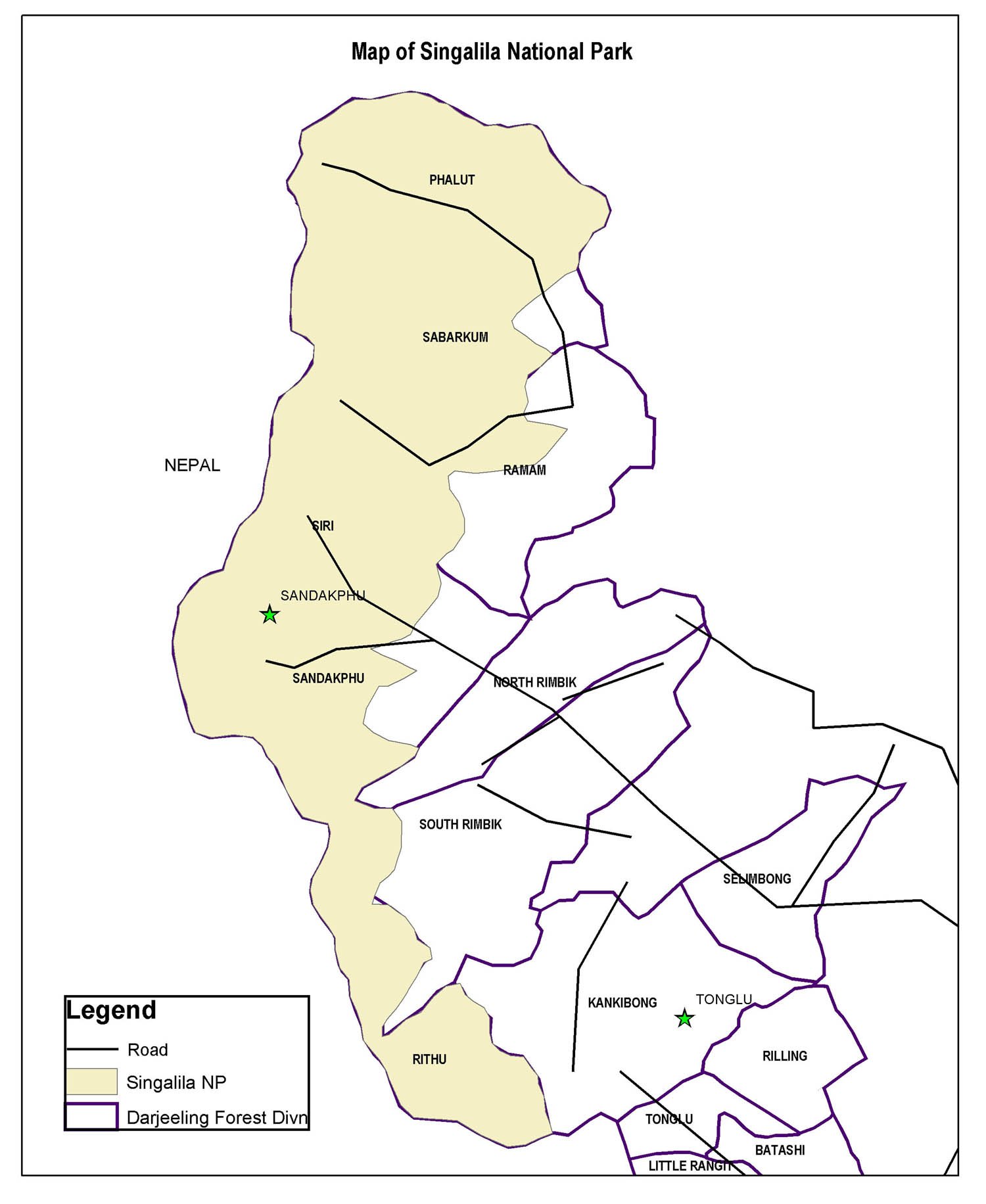
Singalila National Park is located on Singalila Ridge in the Eastern Himalayan region. Sandakphu and Phalut, the two of the highest peaks in West Bengal, are located right inside the park. There are two rivers flowing through the park; River Rammam and River Sirikhola.
Because of the park’s range in altitude, it includes three separate biomes, ranging from subalpine to subtropical, and three corresponding ecoregions:
• The Eastern Himalayan subalpine conifer forests ecoregion, of the temperate coniferous forests biome
• Eastern Himalayan broadleaf forests ecoregion, of the temperate broadleaf and mixed forests biome
• Himalayan subtropical pine forests ecoregion, of the subtropical coniferous forest biome
The subtropical biome roughly exists in the altitude range of 1800 to 3000 m, and the temperate biome exists in the altitude range of 3000 m to 4500 m.


Flora –
Thick bamboo, oak, magnolia and rhododendron forest between 2000 and 3600 m cover the Singalila Ridge. There are two seasons of wildflower bloom – one in spring (March – April) when the Rhododendrons bloom, and another in the post monsoon season (around October), when the lower forests bloom (Primula, Geranium, Saxifraga , Bistort, Senecio, Cotoneaster and numerous orchids). Sandakphu is known as the “mountain of poisonous plants” due to the large concentration of Himalayan Cobra Lilies (Arisaema) which grow there.

Fauna –
Mammals:
The park has a number of small mammals including the Red Panda, Leopard Cat, Barking Deer, Yellow-throated Marten, Wild Boar, Pangolin and the Pika. Larger mammals include the Himalayan Black Bear, Leopard, Clouded Leopard, Serow and the Takin. Tigers occasionally wander into the area, but do not have a large enough prey base to make residence in these forests feasible.
Birds:
The park is a birder’s delight with over 120 species recorded including many rare and exotic species like the Scarlet Minivet, Kalij Pheasant, Blood Pheasant, Satyr Tragopan, Brown and Fulvous Parrotbills, Rufous-vented Tit, and Old World babblers like the Fire-tailed Myzornis and the Golden-breasted Fulvetta. The park is also on the flyway of many migratory birds.
Reptiles and Amphibians:
The endangered Himalayan Newt frequents the region, and congregates around the lakes of Jore Pokhri, Sukhia Pokhri and nearby lakes to reproduce. Jore Pokhri and Sukhia Pokhri are within 20 km of the park boundary, and are protected wildlife sanctuaries.
☆ Best Time To Visit :
There are two seasons to visit Singalila National Park.
Spring season (March until May): It is during this season when the flora and fauna of the Singalila National Park region is at its peak. The whole forest is blooming with rhododendrons and orchids of various kinds.
Autumn-Winter(October until December): This is the time when all your focus will be on the snow white peaks adorning the clear sky of the park.
Park is closed during monsoons i.e. from June until September due to heavy downpour.
☆ VIEW FROM SINGALILA NATIONAL PARK & SIGHTSEEING :
Here is a list of the best things to do in Singalila national park that will give you a unqiue experience of holidaying there!
• Singalila National Park Tour
Spot exotic wildlife and flora while you take a tour through the park. Play peek-a-boo with rare and exotic Red Panda, which are the precious residents of the national park. In Singalila national park, animals that you will find are Himalayan Black Bear, Yellow throat-ed Marten, and Clouded Leopard. Apart from that, it is home to 120 species of Himalayan and Indo-Burma birds.


There is a gravel road that goes through the park. You can only roam around the park in a jeep safari as it can be too dangerous to go inside the wild forests.
• Trek To Sandakphu And Phalut
When you are in Singalila National Park, trek to Sandakphu and Phalut is a must. The trail of Singalila National Park anyway goes all the way to Sandakphu, the highest peak in West Bengal. The panoramic views of the gigantic Himalayas you get from uptop are unlike anything. The views of sunrise and sunset from this point are breathtaking.
You can either go there by jeep or if you want to enjoy nature at a slower pace, you can go for a 3-day trek from Manebhanjan to Manebhanjan. There are many local operators who organize this trek. You can contact them for costing and arrangements.

• Sandakfu
Sandakphu or Sandakfu is the highest peak in the state of West Bengal, India. It is the highest point of the Singalila Ridge in Darjeeling district on the West Bengal-Nepal border.

• PHALUT
Phalut or Falut is the second highest peak of West Bengal, India. Part of the Singalila Ridge in the Himalayas, it is located at the border of the Indian states of West Bengal and Sikkim and of Nepal .


• Tonglu lake


• Rammam River


• VERSEY


☆ How to reach –
By road: Singalila National Park is well connected by road. But the roads are circular and the journey can feel like wave motion.
The road route from Siliguri
Siliguri > Sukna > Rangtong > Kurseong> Tung > Sonada> Ghoom> Manebhanjan > Tonglu – 90 km.
By rail: The nearest railway station of is Ghoom Railway Station 31 km from Tonglu (entry point to the Singalila National Park).
By air: Singalila National Park is located 13 km from Bagdogra Airport in Bagdogra. That is the nearest airport, but by road it is less than 100 km and takes 3 to 4 hours.
- : Nepal Earthquake Of 2015 :
- Singalila National Park
- DARINGBADI
- ~~:QUTUB MINAR TOUR:~~
- # TODAY AFTER RAIN
MY NEW YOUTUBE
 ACHIN PAKHI