
# Fatehpur Sikri 3rd September 2019,
Tour Timeing 9.25 am
Built during the second half of the 16th century by the Emperor Akbar, Fatehpur Sikri (the City of Victory) was the capital of the Mughal Empire for only some 10 years. The complex of monuments and temples, all in a uniform architectural style, includes one of the largest mosques in India, the Jama Masjid.
This magnificent fortified ancient city, 40km west of Agra, was the short-lived capital of the Mughal empire between 1572 and 1585, during the reign of Emperor Akbar. Earlier, Akbar had visited the village of Sikri to consult the Sufi saint Shaikh Salim Chishti, who predicted the birth of an heir to the Mughal throne. When the prophecy came true, Akbar built his new capital here, including a stunning mosque, still in use today, and three palaces, one for each of his favourite wives – one a Hindu, one a Muslim and one a Christian (though Hindu villagers in Sikri dispute these claims).
The city was an Indo-Islamic masterpiece, but was erected in an area that supposedly suffered from water shortages and so was abandoned shortly after Akbar’s death. The red-sandstone palace walls are at their most atmospheric and photogenic near sunset. Fatehpur Sikri Mosque is said to be a copy of the mosque in Mecca and has designs, derived from the Persian & Hindu architecture.
☆ Buland Darwaza :
This gate can be approached from the outside by a 13-metre flight of steps which adds to its grandeur. The gate erected in 1602 AD to commemorate Akbar’s victory. The highest and grandest gateway in India and ranks among the biggest in the world.


☆ The Jami Masjid :


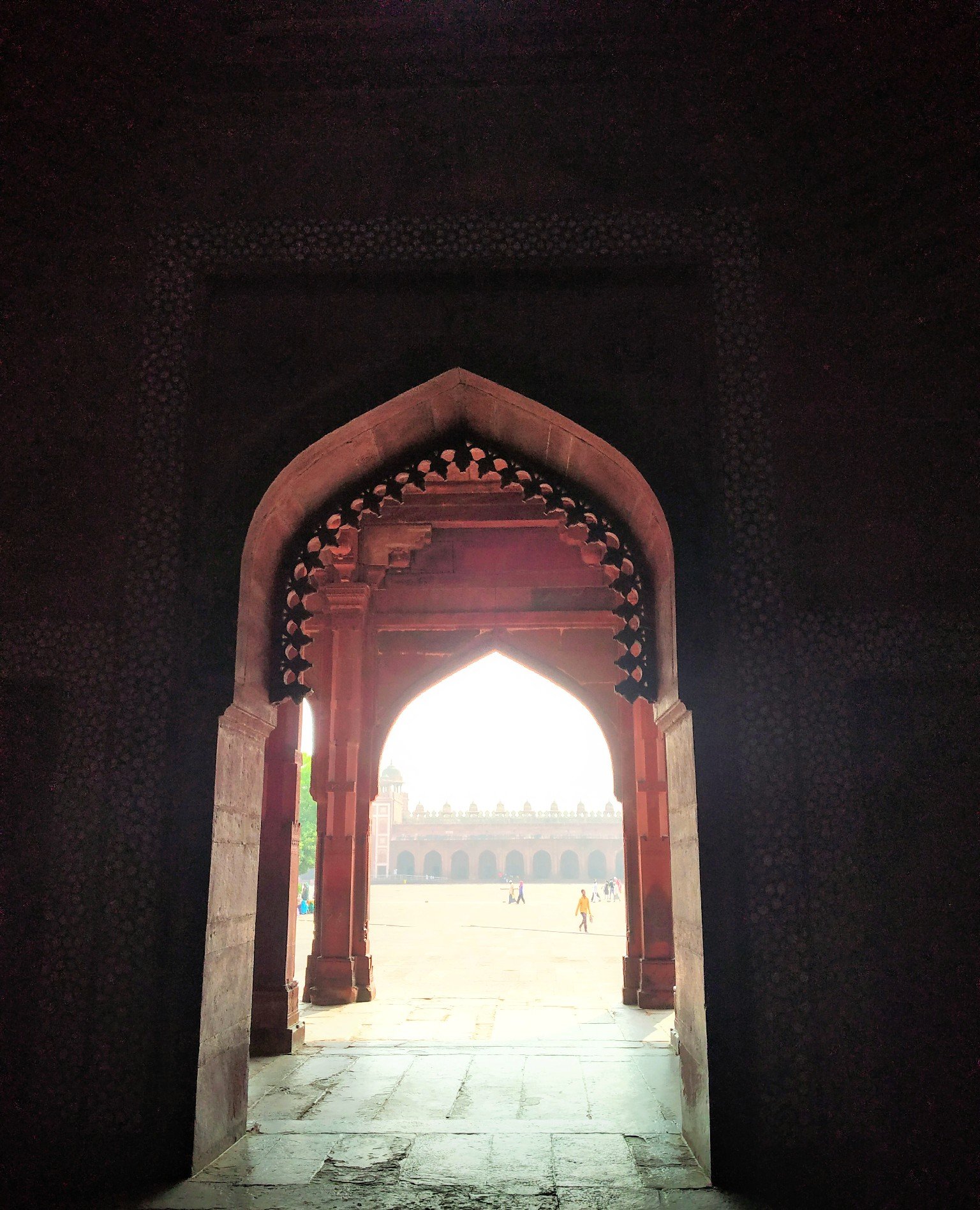
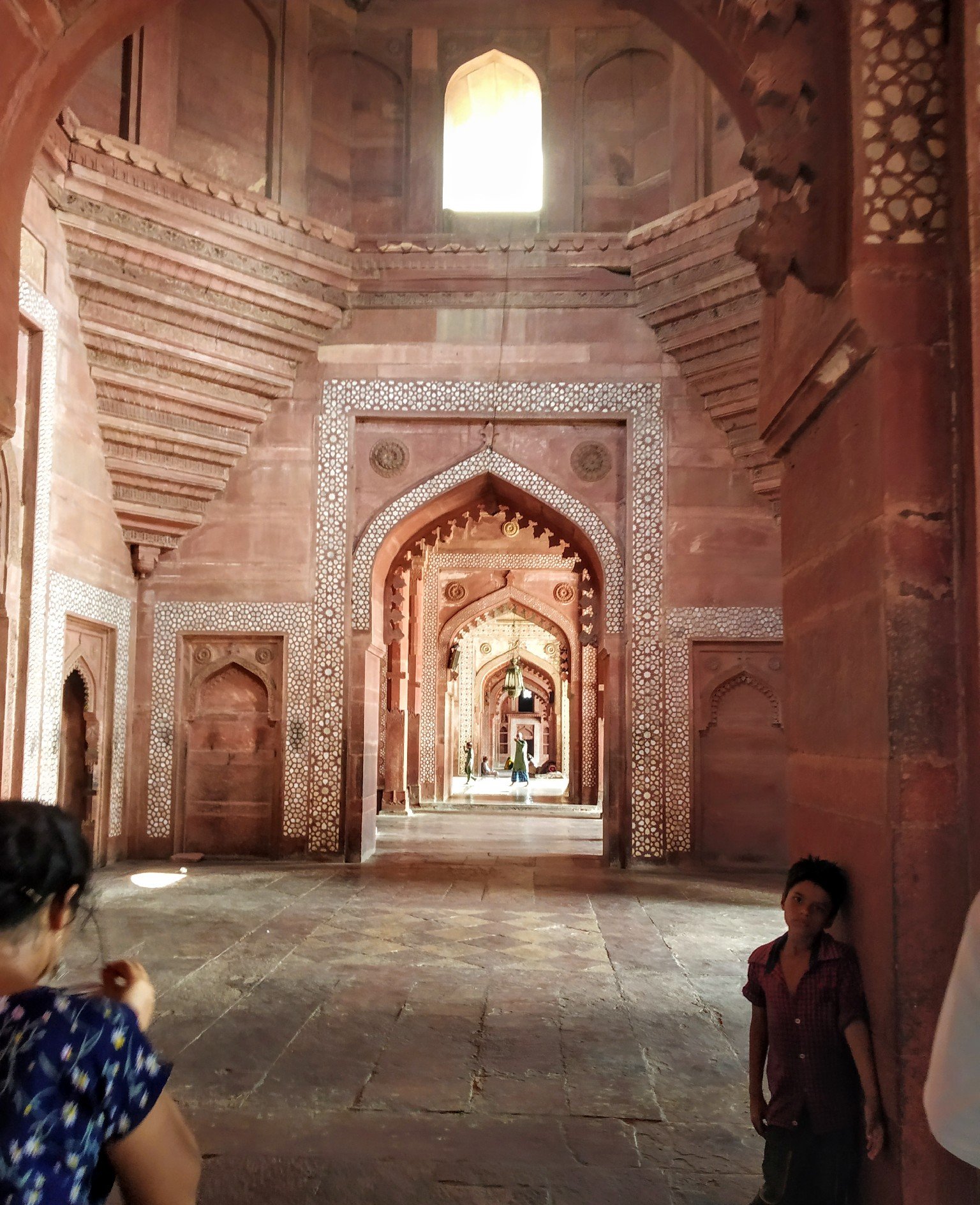
One of the largest mosques in India, Jami Masjid was built in 1571 AD.
☆ Palace of Jodha Bai :


This spacious palace was assured of privacy and security by high walls and a 9 metre guarded gate to the east. The architecture is a blend of styles with Hindu columns and Muslim cupolas.
☆ Hawa Mahal OR Panch Mahal :


☆ Daulat khana-I-khas :

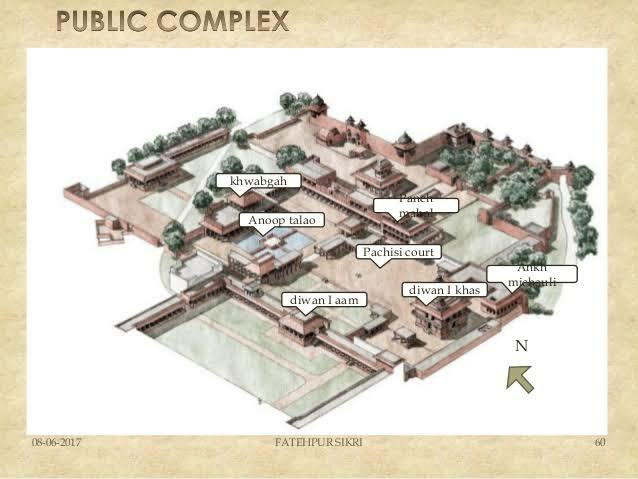
Located in the corner to the left is the emperor’s private chamber. It has two main rooms on the ground floor. One housed Akbar’s library while the larger room was his resting area. On the first floor is the Khwabgah or the bed-chamber.
☆ Turkish Sultana’s House :

☆ The Treasury :


To the left of the Diwan-I-Khaas is the Treasury or Ankh Michauli, once believed to have been used for playing the game, comprising three rooms each protected by a narrow corridor which were manned by guards.
☆ Diwan-khana-I-khaas :


To the right is an apparently looking two storeyed building, with corner kiosks, known as diwan-khana-I-khaas or Hall Of Private Audience. On entering it, one finds only a single vaulted chamber. In the centre stands a profusely carved column supporting a collosal-bracketed capital. Four narrow causeways project from the centre and run to each corner of the chamber. It is believed that Akbar’s throne occupied the circular space over the capital and the corners were assigned to the four ministers.
☆ Diwan-I-Am :

Diwan-I-Am or the Hall Of Public Audience. This hall was also used for celebrations and public prayers. It has cloisters on three sides of a rectangular courtyard. To the west is a pavilion with the Emperor’s throne. Beautiful jali screen on either sides separated the ladies attending the court.
☆ Sheesh Mahal :


☆ Tansen Chabutra :

~: GALLERY :~


 ACHIN PAKHI